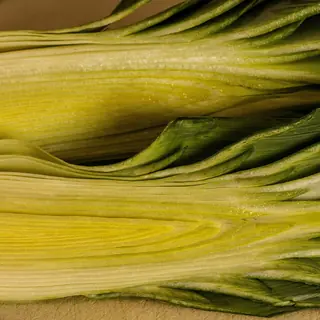
Leek
Vegetables
- 61kcal
- 1.5 gprotein
- 3 gfibre
Per 100 g, raw.
What 100 g is made of
- Protein 1.5 g
- Fat 0.3 g
- Carbohydrate 14.2 g
- Water and other 84.1 g
“Water and other” is what is left of 100 g after protein, fat and carbohydrate (mostly water, plus ash).
Vitamins and minerals in 100 g
Bars show the share of the US adult daily value. The rank compares 260 ingredients.
- Sodium17.7 mg · <1% · #133 of 258
- Potassium319 mg · 7% · #95 of 256
- Calcium51.4 mg · 4% · #102 of 258
- Iron0.76 mg · 4% · #137 of 259
- Magnesium15.7 mg · 4% · #163 of 256
- Zinc0.29 mg · 3% · #169 of 256
- Vitamin C12 mg · 13% · #72 of 239
- Folate64 µg · 16% · #54 of 237
- Vitamin A83 µg · 9% · #48 of 237
- Vitamin B120 µg · 0% · #66 of 236
Where it comes from
- 2000–1000 BCELeeks were eaten in ancient Egypt by at least the second millennium BCE.Egypt
- 1 CE–100 CEThe cookbook Apicius included four leek recipes in the first century CE.
Used in GlobeCooks dishes from: Europe (2), Africa (1), Asia (1)
Native range and history are drawn from Wikipedia and Wikidata by GlobeCooks.
More vegetables
Nutrients: USDA FoodData Central (food 169246, 2727584), public domain. Identity: Wikidata Q1807269. Compiled by GlobeCooks.