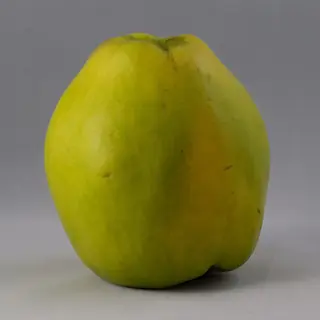
Quince
Cydonia oblonga
Fruit · Rosaceae family
- 57kcal
- 0.4 gprotein
- 1.9 gfibre
Per 100 g, raw.
What 100 g is made of
- Protein 0.4 g
- Fat 0.1 g
- Carbohydrate 15.3 g
- Water and other 84.2 g
“Water and other” is what is left of 100 g after protein, fat and carbohydrate (mostly water, plus ash).
Vitamins and minerals in 100 g
Bars show the share of the US adult daily value. The rank compares 260 ingredients.
- Sodium4 mg · <1% · #188 of 258
- Potassium197 mg · 4% · #168 of 256
- Calcium11 mg · <1% · #197 of 258
- Iron0.7 mg · 4% · #142 of 259
- Magnesium8 mg · 2% · #220 of 256
- Zinc0.04 mg · <1% · #233 of 256
- Vitamin C15 mg · 17% · #63 of 239
- Folate3 µg · <1% · #195 of 237
- Vitamin A2 µg · <1% · #138 of 237
- Vitamin B120 µg · 0% · #66 of 236
Where it comes from
Native to: Iran (Islamic Republic of)
- about 1275Quinces were recorded in England around 1275, when Edward I had them planted at the Tower of London.United Kingdom of Great Britain and Northern Ireland
- 1600sSettlers brought quince to North America during the 17th century.Northern America
- 1700sSettlers brought quince to Central and South America during the 18th century.Central America, South America
Used in GlobeCooks dishes from: Asia (1)
Native range and history are drawn from Wikipedia and Wikidata by GlobeCooks.
More fruit
Nutrients: USDA FoodData Central (food 168163), public domain. Identity: Wikidata Q2751465. Compiled by GlobeCooks.