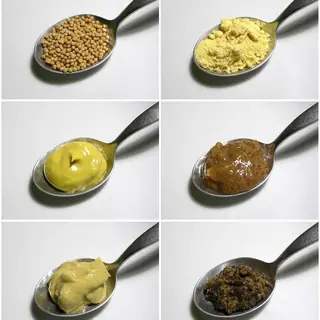
Mustard
Condiments & seasonings
- 61kcal
- 4.3 gprotein
- 4.3 gfibre
Per 100 g, raw.
What 100 g is made of
- Protein 4.3 g
- Fat 3.4 g
- Carbohydrate 5.3 g
- Water and other 87.1 g
“Water and other” is what is left of 100 g after protein, fat and carbohydrate (mostly water, plus ash).
Vitamins and minerals in 100 g
Bars show the share of the US adult daily value. The rank compares 260 ingredients.
- Sodium1,100 mg · 48% · #11 of 258
- Potassium150 mg · 3% · #193 of 256
- Calcium63 mg · 5% · #89 of 258
- Iron1.6 mg · 9% · #104 of 259
- Magnesium47.7 mg · 11% · #74 of 256
- Zinc0.64 mg · 6% · #119 of 256
- Vitamin C0.4 mg · <1% · #147 of 239
- Folate7 µg · 2% · #169 of 237
- Vitamin A4 µg · <1% · #127 of 237
- Vitamin B120 µg · 0% · #66 of 236
Where it comes from
- 900sMonks in Paris began making mustard.France
- 1390An English cookery book records mustard being used as a condiment.United Kingdom of Great Britain and Northern Ireland
- 1904A bright-yellow mustard was introduced at the St. Louis World's Fair.United States of America
Used in GlobeCooks dishes from: Europe (2)
Native range and history are drawn from Wikipedia and Wikidata by GlobeCooks.
More condiments & seasonings
Nutrients: USDA FoodData Central (food 172234, 326698), public domain. Identity: Wikidata Q131748. Compiled by GlobeCooks.